
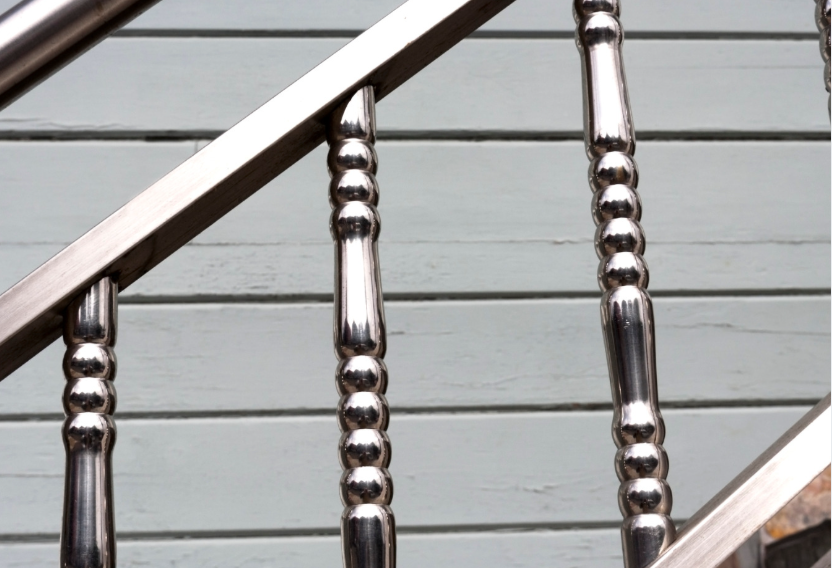
The right stainless steel railing grade for saltwater pools depends on whether the railing is immersed, frequently splashed, or positioned farther from the water. Grade 316 is more corrosion-resistant than 304 in many chloride environments, but it should not be treated as a universal specification for saltwater pool equipment.
Key Takeaways
- Select the grade for the actual exposure—not simply because it is labelled “marine grade.”
- Grade 316 offers greater chloride resistance than 304, but it is not corrosion-proof.
- Immersed or heavily splashed saltwater components may require substantially higher-alloy stainless steel.
- Indoor pool atmospheres introduce additional corrosion risks.
- Surface finish, weld treatment, drainage, and maintenance affect performance.
- Confirm the complete railing specification, including fasteners and anchors.
Is Grade 316 Always Suitable Around a Saltwater Pool?
No. A perimeter railing separated from direct splashing faces different conditions from a handrail that extends into the water.
Saltwater chlorination systems maintain dissolved salt in the pool. The resulting chloride exposure can be more demanding than that of a conventional freshwater pool.
Grade 316 contains molybdenum, which improves resistance to localized corrosion compared with 304. However, that improvement does not make it suitable for every salt concentration, temperature, or exposure pattern.
For immersed or heavily exposed components, obtain a recommendation based on the water chemistry and intended service conditions.
When Might a Higher-Alloy Grade Be Needed?
Saltwater pool ladders, immersed handrails, and other components in sustained contact with saline water may need alloys beyond standard 304 or 316.
Potential options include certain 6% molybdenum stainless steels or super duplex grades. These are specialist materials—not interchangeable upgrades that can be selected by appearance.
A corrosion specialist or suitably experienced designer should assess:
- Salt and chloride concentrations
- Water temperature
- Sanitizer levels and operating conditions
- Immersion and splash frequency
- Opportunities for rinsing and drying
- Crevices and inaccessible connections
The fabricator must also have the expertise to work with the specified alloy.
Does an Indoor Pool Change the Assessment?
Yes. Warm, humid indoor pool atmospheres can create aggressive deposits on metal surfaces.
Some stainless steels can experience stress corrosion cracking under particular combinations of material, stress, and exposure. Safety-critical components that are difficult to clean deserve particular attention.
Do not transfer an outdoor railing specification to an indoor pool enclosure without review. Ventilation, cleaning access, component location, and connection design all influence the assessment.
Why Do Finish and Weld Quality Matter?
A suitable grade can still perform poorly if fabrication leaves contamination, rough surfaces, or moisture-trapping details.
Smooth, clean finishes are generally easier to maintain. Welded areas need appropriate finishing and treatment, while joints should minimize locations where salty water can collect.
Ask the supplier to specify:
- Stainless steel grade for each component
- Surface finish
- Weld-cleaning and finishing procedures
- Fastener and anchor materials
- Drainage and crevice-control details
- Required maintenance
The “L” in 316L indicates a low-carbon variation useful in welded applications. It does not transform 316 into a saltwater-proof material.
What Maintenance Should Be Planned Before Winter?
Follow the fabricator’s cleaning instructions and rinse accessible salt deposits with fresh water where appropriate.
Before November and December freeze-ups, inspect base plates, connections, and sheltered areas where deposits may remain. Avoid abrasive tools that introduce ordinary steel contamination or cleaners incompatible with the finish.
Rust staining, pitting, loose connections, or cracking warrants professional assessment. Cleaning alone does not establish that a damaged railing remains structurally sound.
Discuss the Exposure Before Choosing the Railing
Railings Toronto, operated by Pro Weld, provides custom stainless steel and glass railing fabrication and installation. Share the pool’s water specifications and identify which components will be immersed, splashed, or sheltered. Ask the team to confirm material suitability and whether specialist input is needed before approving a saltwater-pool railing specification.